How Long Until Your First Print on Demand Sale?

Getting your first print on demand sale is a real milestone. Not for the money, because the money is a few dollars. For the proof. Something you made went in front of a stranger and they pulled out their card for it.
If you're already there, congratulations. That one is worth sitting with.
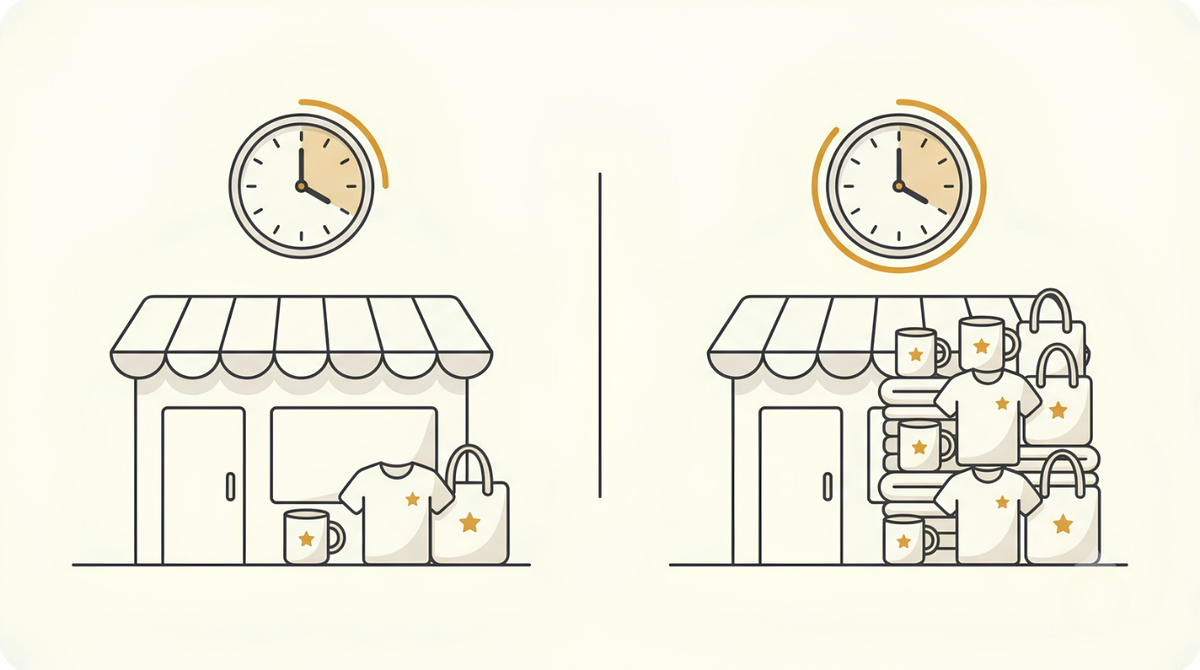
And if you're not there yet, staring at a shop with no orders and wondering how long this is supposed to take, the honest answer is that it depends entirely on where you're selling. My first Etsy sale came 8 days after I opened the shop with just 50 products. My first Amazon sale came after I had posted around 10,000 products.
Same person, same work, two completely different clocks.
Every platform sells on a different lever
Each platform has one thing that decides whether you sell on it. Pull that lever and orders start showing up. Push on everything else and you can work for months without moving.
On Etsy, the lever is the product itself. On Amazon, it's volume. Neither one is a shortcut, and neither one is optional. They're just different jobs, and knowing which job you're actually doing is what tells you whether 50 or a few thousand products is the number to expect.
Etsy shows your product to people, so the product has to land
Etsy pushes your listings in front of customers on its own. You are not buried under millions of other products, and you don't have to fight for the first bit of traffic. People will see what you made.
That takes the traffic problem off the table and puts everything on the product. The design has to genuinely resonate with the person you made it for. The mockups have to do the same, because the mockup is what a shopper actually sees before they see anything else. And the SEO has to bring in specific traffic, the exact people that design was made for, not the widest crowd you can attract.
Here's what that looked like for me. First sale 8 days after opening the shop, on 44 visits, with around 50 products listed.
44 visits is nothing. That's a handful of people over a week.
It sold because the right product was in front of the right people, not because a lot of people showed up.
I don't run Amazon Merch, but from everything I've seen, the levers there work much the same way. Amazon puts Merch designs in front of shoppers for you, so the design carries the weight.
Amazon FBM buries you, so volume is the job
Amazon works the other way around. On FBM (Fulfilled by Merchant, where you own the listing and your supplier prints and ships each order), nobody is handing your new product an audience. It goes live into a catalog with millions of other things in it, and it sits there.
So you do everything you did for Etsy. Good design, good mockups, keywords that match what your buyer types. Then you do it a lot more times.
On Amazon, the volume is what gets you seen.
My first sale there came after roughly 10,000 products posted and about 2 weeks of work. Not because the first 9,000 were bad, but because it takes that much catalog before Amazon starts pushing any of it toward the people who want it.
That number sounds impossible until you stop making products one at a time. Getting to that kind of volume is a build, not a grind, and I wrote out the system I use to do it here.
Find your platform's lever, then check your own
Every platform is different, so "how long until it sells" only has an answer once you name where you're selling and what that place rewards. A week on one, a few thousand products on another.
If you're past the point where the timeline explains it, and you want to work out which part of your setup is actually missing, the three step funnel is where I'd start looking: being seen, getting clicked, then getting bought. I broke that down here, including how to read your own numbers to find which step is leaking.
Waiting on a first sale is a lot easier when you know what you're waiting on.
If you want to see how the rest of it plays out, the slow stretches and the numbers behind them, you can follow the build by email.
Keep at it,
Nick T