[Part 1] Why Nothing's Selling, and Where to Actually Look

A product that isn't selling looks like one big wall. It isn't.
When nothing sells, it's easy to decide the whole thing failed. The idea, the design, the method, all of it. So people scrap it and go start over somewhere new.
But a product that doesn't sell is never failing at one thing. It's failing at one of three, and usually only one of them is actually broken.
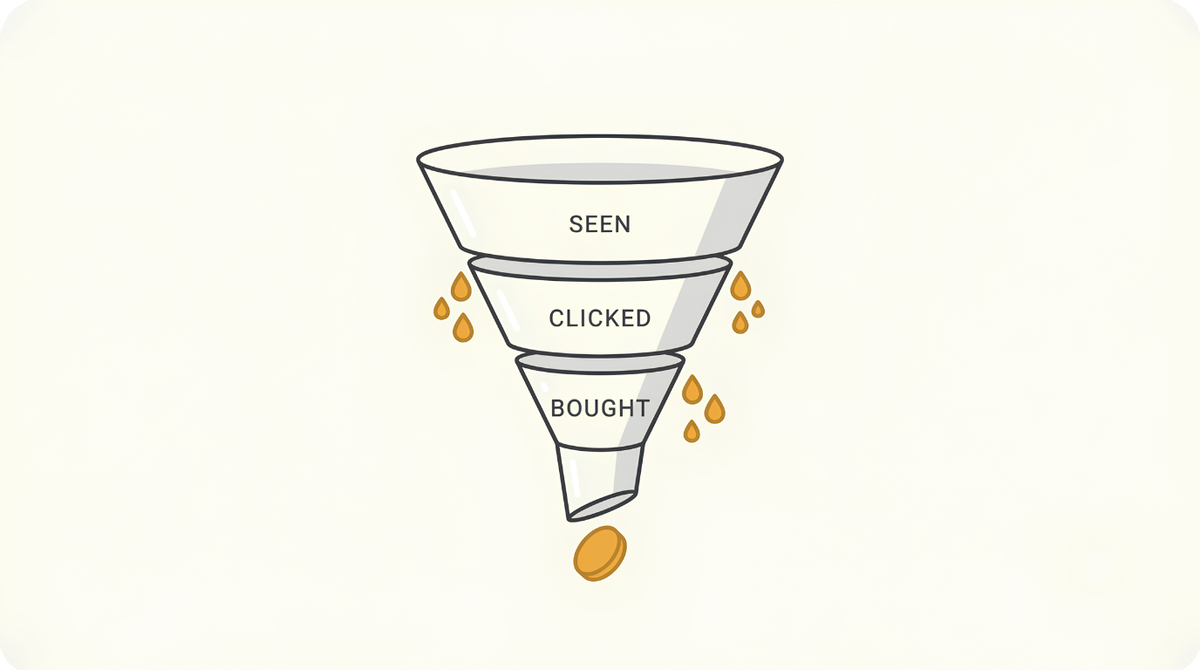
Money only shows up after your product clears three steps. People have to see it. Some of them have to click it. Some of those have to buy it. See, click, buy. Skip any one and the sale never happens, no matter how good the other two are.
"No sales" is three different problems wearing the same face.
So the question was never "why won't it sell." It's "which of the three steps is it stuck on?" Answer that, and the fix is usually staring right at you.
The three steps, in plain terms
Before you can spot which step is failing, you need to know what the three actually are. Here they are, top to bottom.
Impressions. How many people see your listing at all. When someone searches and your product turns up in the results, that's one impression. It only means you got in front of a pair of eyes. Nothing more yet.
Clicks. Of everyone who saw it, how many tapped in to look closer. Showing up as a small thumbnail in a row of twenty and getting the actual click are two very different things.
Conversions. Of everyone who clicked in, how many bought. This is the only step that puts money in your account.
These run in order, and each one feeds the next. It's a funnel: wide at the top, narrow at the bottom. A hundred people see it, twenty click, two buy. Every stage keeps only a slice of the one above it.
Which is why a leak near the top starves everything below. If nobody sees your listing, your price could be perfect and it wouldn't matter. Nobody ever got close enough to read it.
You can't fix a sale you can't find. First work out which step is leaking.
Find the leak before you touch anything
Here's the good news: you don't have to guess where the leak is. Your marketplace already counts it for you. It shows how many people saw each listing, how many clicked, and how many ordered. Read across those three numbers and watch for the point where it falls off a cliff.
Barely any impressions? People aren't seeing it. That's not a design problem and it's not a price problem. Either nobody's searching for what you made, or you're not showing up when they do.
Plenty of impressions, almost no clicks? They see it and scroll right past. The listing isn't pulling the right people in.
Good clicks, but no orders? They showed up, looked, and left. Something on the page didn't give them enough reason to pull the trigger.
Same symptom, "no sales," three completely different causes. Fixing the wrong one is why so much effort leads nowhere. You could rewrite every title you have, but if the real problem was that nobody searches for your idea in the first place, you just polished something no one will ever see.
🔎 Diagnose, then fix. Look at your three numbers before you change a single thing. The step where the count collapses is the only step worth your time this week.
The fastest way to understand any of it
One thing will teach you more about all three steps than any guide, and it costs a few dollars. Go buy something yourself.
Open the same marketplace you sell on and shop for real. Not your own product, anything you'd actually want.
Then watch yourself do it. What did you type into the search bar? Of everything that came up, which listings did you even glance at, and why those? What made you click one over the ten sitting next to it? And when you finally bought, what tipped you over: the price, the reviews, a photo, the feeling it was made for you?
That path, search then click then buy, is the exact funnel your customer walks. Feeling it from their side is worth more than reading about it from yours.
Because most products fail for a simple reason: they were built for the seller, not the buyer. You liked the design, so you assumed a stranger would search for it, find it, and pay for it.
You're not the customer.
You're not making products for yourself. You're making them for someone you've never met.
Someone who shops nothing like you'd assume. The whole game is climbing out of your own head and into theirs.
Try it now: shop your own marketplace
Search like a customer.
Type in what a real buyer would, not your product name. Notice the words that actually come to mind.
Watch what earns the click.
Of the first listings you see, which ones pull your eye, and what is it: the image, the title, the price?
Catch the moment you decide.
When you buy, name the one thing that tipped you over. That's the thing your own listing has to give the next person.
Once you stop reading "no sales" as one dead end and start seeing three separate steps, the panic drops. A product that isn't selling isn't proof the method is broken, and it isn't a reason to go chase a shinier one, which usually backfires anyway. It's a signal, and it's pointing at one specific step that needs your attention.
Find the step. Then fix that, and only that.
I'm documenting this whole troubleshooting walkthrough out in the open, the same way I work through it in my own store. If you want each piece as it lands, come along by email or you can read it here.
Now go find the leak,
Nick T