The Print on Demand Method Nobody Tells You About

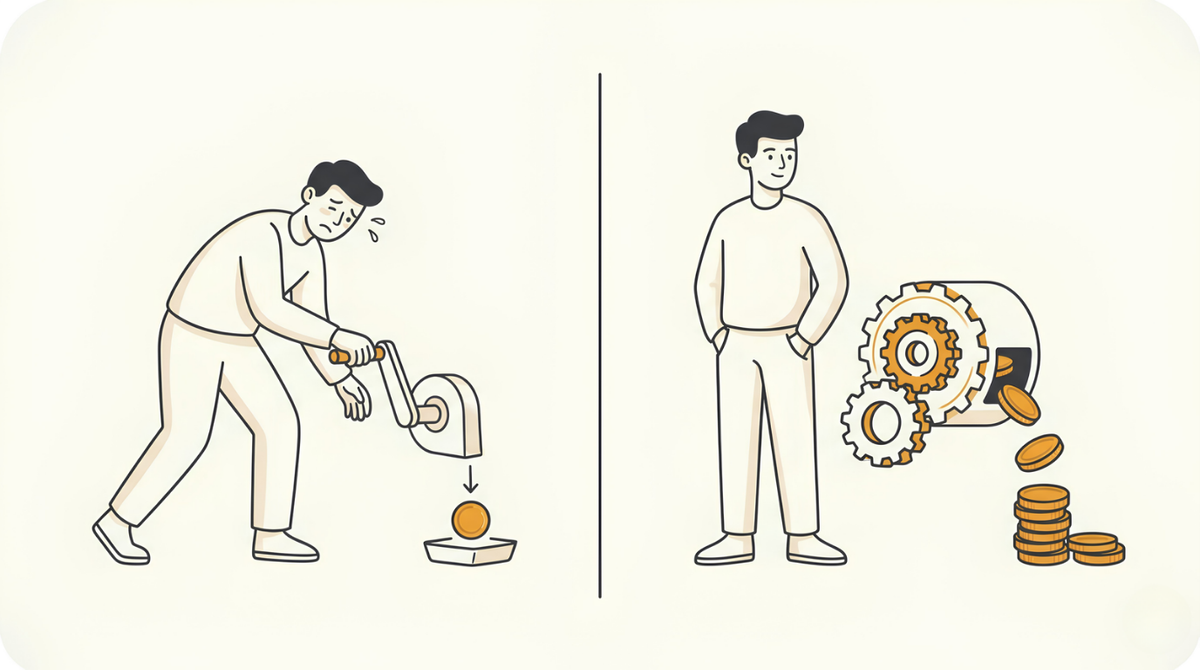
Most people spend their whole life working for money.
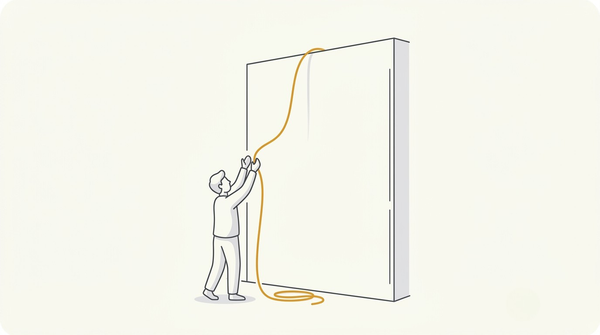
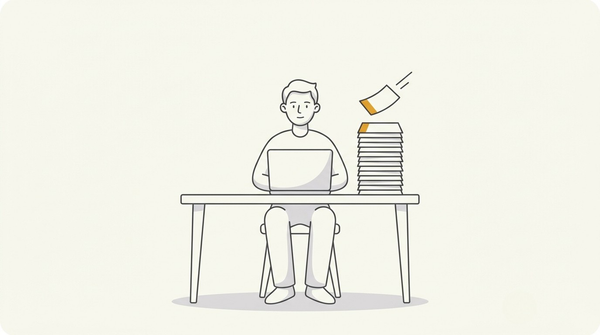
You trade your hours for a paycheck. You show up, you put in the time, the money comes in, and then it stops the second you stop. Take a week off and that week pays you nothing. The whole thing only runs while you keep pushing on it, and the day you stop pushing is the day it goes quiet.
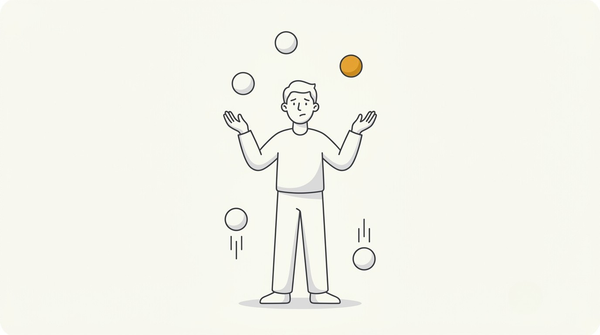
For a long time that was the only way I knew too. And maybe you've already gone looking for something better. Maybe you've even tried print on demand, or dropshipping, or one of the other things the internet swears will set you free, and it didn't go anywhere.
Stick with me. There is another way to do this, and it doesn't ask you to work harder or longer.
It asks you to work once.
A business that works while you don't
Here's the whole idea in one line: instead of trading your time for money, you build something one time that keeps earning after you walk away.
Picture a machine. You don't get paid for standing there turning the handle. You get paid for building the machine in the first place, and then for making it bigger and better over time. The money that comes out is a side effect of a system that runs on its own.
That is the real shift, and it quietly changes everything about how you spend a day.
When you work for money, your only lever is hours. More money means more hours, and you run out of those fast. When you work on a system, your lever is the system itself. You make it a little better, a little bigger, and it pays you more without asking for more of your time.
You don't work for the money. You work on the system, and the system works for the money.
Plenty of online businesses promise exactly this and almost none of them deliver it. The whole game is picking one where the work actually stacks up instead of resetting to zero every morning. So let me show you the one I'd point anyone to first.
So what is print on demand?
Print on demand is one of the cleanest versions of that machine, so let me explain it from the ground up, even if you have never heard the words before.
Print on demand is a business where you make a design once, people can buy it on a product forever, and you never touch the product yourself.
Here is the whole loop. You create a design, something as simple as a line of text or a small piece of art. You put it on a product, a shirt, a mug, a poster, a tote bag, whatever fits. You list that product on a marketplace where shoppers are already looking. Someone buys it. The order goes straight to a supplier who prints your design on the product and ships it to the customer's door. You never hold any stock, you never go to the post office, you never see the box.
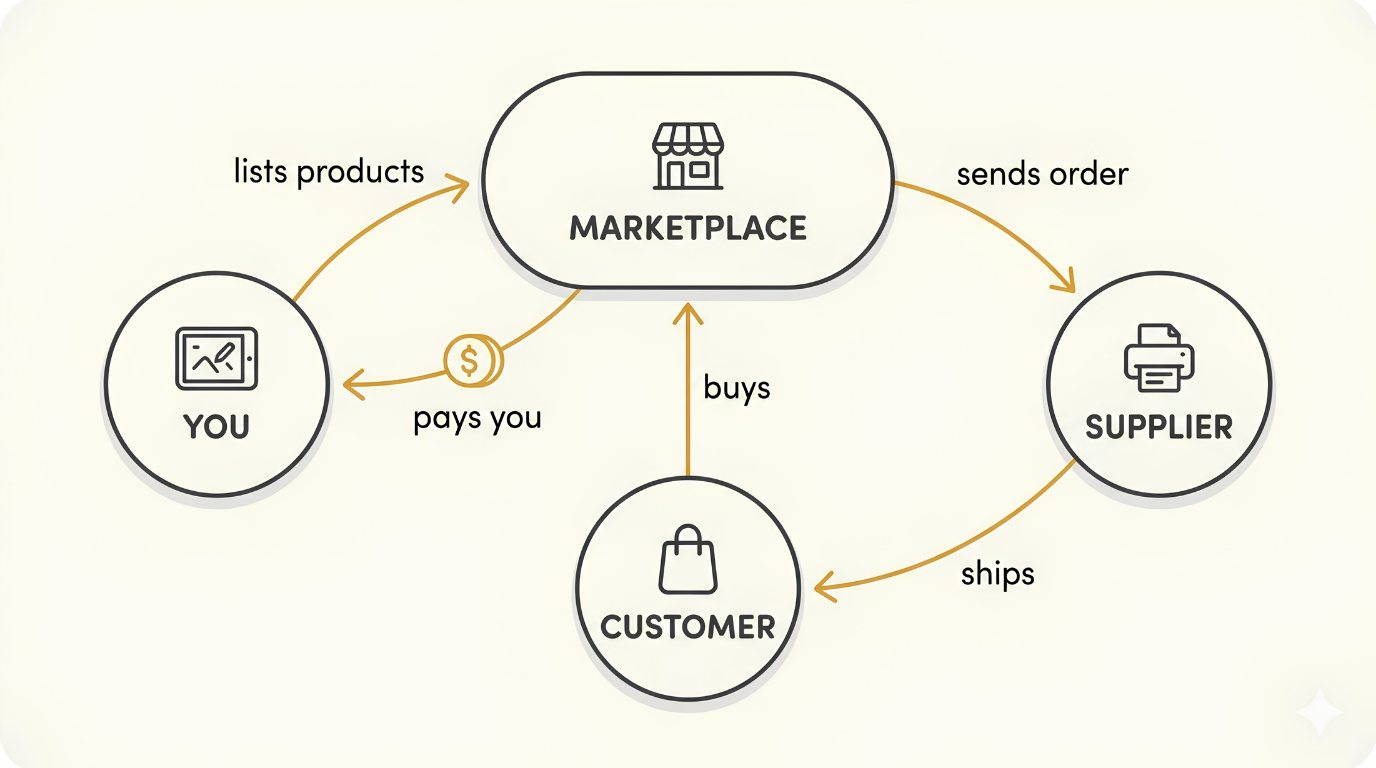
Look at what you actually did. You made the design and you listed it, one time. Every sale after that runs through the same loop without you lifting a finger. Make it once, it can sell a hundred times, or a thousand.
That is the machine in its simplest form, and it is why print on demand is the route.
My method, and why I think you can't really lose
Here is where I do things differently from almost everyone else in print on demand.
The usual advice points you to one of a few places, and every single one of them quietly works against you when you are new and still learning.
Amazon Merch is hard to even get into, and once you are in, it caps how many products you can list until you prove yourself with sales. You are basically asked to be good before you have been given any room to learn.
Etsy charges you for every listing you put up. So you can only afford to post a handful at a time, which means you are forced to hunt for a winning design from the very start. Picking winners is the one thing nobody is good at on day one, and Etsy makes you bet on it anyway.
Shopify, TikTok Shop, and Amazon FBA all cost real money up front. You are paying for ads, building a website, sometimes buying inventory, all before you know whether a single thing will sell.
See the pattern. Every popular route makes you pay to learn, either in money or in caps, at the exact moment you know the least. That is backwards.
Then there is Amazon FBM. You pay one flat subscription, around $39.99 a month, and that is the whole cost. There is no charge per product. Listing one product costs the same as listing a thousand.
💡 The real unlock. Past that one flat subscription, every extra product you list is free, so the only thing capping your catalog is how fast you can make and post designs.
Sit with what that unlocks. Once listing is free past that subscription, the only thing between you and a massive catalog is the work of making and posting all those products. And work is exactly the kind of problem a system is built to solve.
So that became my entire bet. Build a system that handles the making and the posting for me, then let it run at scale. I am not trying to find one perfect winner and pour everything into it. I am putting out a huge range of designs, because when each listing costs nothing, the sheer breadth becomes the edge. With enough products live at good quality, the winners find me instead of the other way around.
And this is the part I keep coming back to.
There is almost nothing to lose.
The downside is a monthly subscription. The upside is a catalog that keeps earning while it just sits there. You don't even have to be brilliant at picking designs, because you are never betting the business on any single one. You get room to learn out loud, on a platform that doesn't punish you for it.
The routes at a glance
Amazon Merch:
Free to list, but hard to get into and capped by tiers. Little room to learn before you have sales.
Etsy:
You pay per listing, so volume gets expensive fast. Forces you to pick winners from day one.
Shopify / TikTok Shop / Amazon FBA:
Real money up front: ads, a website, sometimes inventory, before you know anything sells.
Amazon FBM:
One flat fee, around $39.99 a month, unlimited listings. One system can run the whole workflow on its own.
So that is the big picture. Work once instead of by the hour. Build a machine instead of a job. And pick the version of it where someone just starting out can't really lose.
That's how I see it now. And once you see it this way, it's hard to unsee.
I hope you start seeing it too.
Talk soon,
Nick T