
How to Prepare for Q4 Without Changing Anything

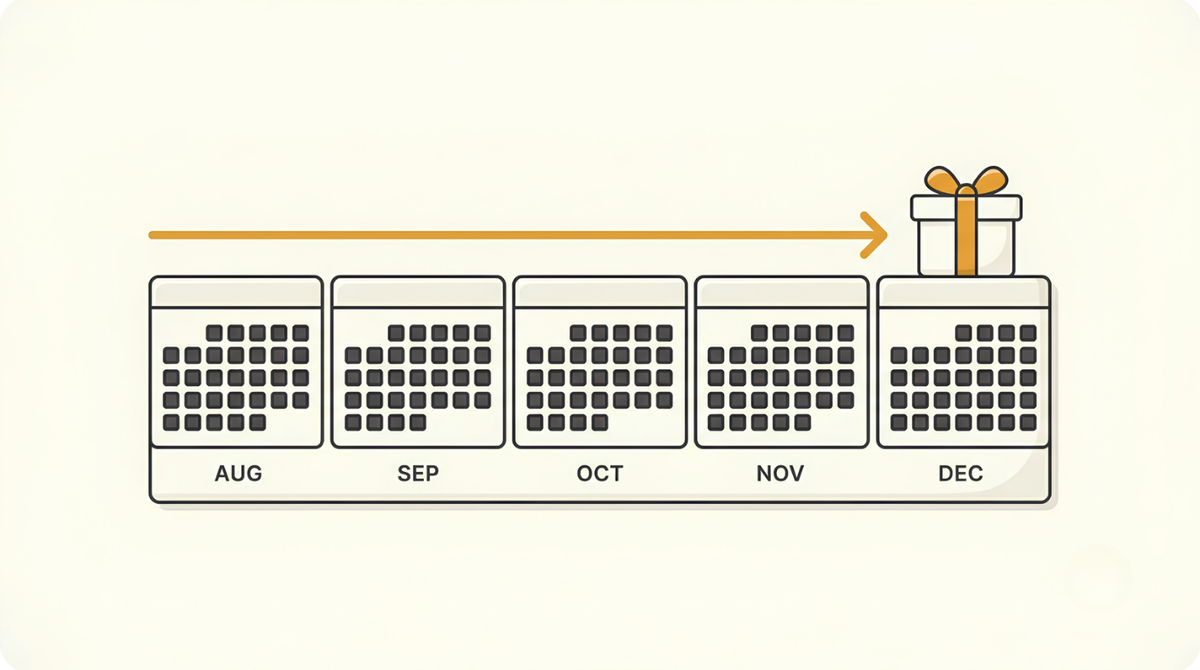
If you want products selling this Christmas, they need to be live in August.
Not because August is special. Because a new listing takes time to get found, and Amazon will not push something it only just met. The products that sell in December are the ones that have been sitting there quietly since summer, collecting a bit of history.
Q4 is the biggest stretch of the year in this business. You have probably heard that already, and it is true. My own first six months ran straight through one, and the month by month numbers are here. The part that usually gets left out is the date. So here is mine.
How I actually prepare for Q4
I do what I was already doing.
More products, into the same niches, using the same system. No new strategy, no seasonal pivot, no month spent rebuilding the way I work. I take the thing that already works and I turn the volume up on it.
That sounds like a non answer, so here is why it holds. Q4 does not reward whoever had the cleverest idea in October. It rewards whoever has the most products in front of the most people when the money starts moving.
Christmas designs are worth a shot, with your eyes open
There is a real case for making Christmas specific products. Christmas designs, Christmas mockups, whatever is trending that year wrapped in a bit of tinsel. It works for people. It might work for you.
Just know what you are walking into. Every seller on every platform has the same idea at the same time, and they all had it in September. You are competing against millions of products built for the exact same six weeks, and yours has no history behind it.
Worth testing. Not worth betting the quarter on.
Everyone buying at Christmas is buying a gift. A gift that fits one specific person beats a gift that fits everyone.
Which is the argument for staying where you are. Think about who is actually shopping in December. They are not looking for a generic Christmas shirt. They are looking for something for their sister who does pottery, or their dad who fishes, or their friend who will not shut up about her cat.
That is a niche product. You already make those. The flat fee method I run is built on posting into small specific niches at volume, and Q4 is the one time of year when the whole market goes looking for exactly that kind of thing.
So the seasonal designs are the optional extra. The niches are the plan.
The timeline I work to
Start posting in August. Keep going through December.
August and September are the build. Nothing dramatic happens, and that is fine, that is not what those months are for. You are getting products indexed and giving them enough runway to be findable by the time buyers show up.
If you are already posting, August is where you push harder rather than start. More runs, more niches, more products out the door. The results at the other end are worth the extra hours now.
Then October arrives and sales start climbing on their own.
What I do once the traffic shows up
Four things, in this order.
- Turn up what is running. If you already have ad campaigns going, raise the bids and raise the budget. More people are searching and more people are buying, so the same campaign is worth more than it was in September. This is the cheapest win available and it takes about five minutes.
- Split out the winners. By October you can see which products are actually selling. Give those their own campaigns instead of leaving them buried in a catch all, or add more campaigns pointed at them. You are putting money behind proven demand rather than guessing.
- Test your price. People are in a buying mood in Q4 and they are less price sensitive than they were in March. Raise a product by 2 or 3 dollars, leave it a full week, and see whether sales hold. If they do, you just made a few dollars more on every order for the rest of the quarter. If they drop, put it back. Cheap test, real upside.
- Copy your winners across. If you sell on more than one platform, take your best seller from one and get it live on the others. The design already proved it works. There is no reason it should only be earning in one place during the busiest weeks of the year.
The one thing that can undo all of it
Handling time.
Handling time is the number of business days you tell the marketplace you need before an order ships. If you use a third party print provider, they set the pace, and they are usually fast. Mine is Printify and I run a 3 day handling time at over 95% on time for most of the year.
The holidays break that. Production queues fill up, everyone is ordering at once, and the turnaround that was comfortable in July stops being comfortable in November. I raise mine to 7 days for that month, on purpose, before I need to.
Late orders are not a small problem. Amazon scores you on late shipments, order defects and cancellations, and if those numbers slip far enough you can lose your ability to sell at all. The customer wanted their gift before Christmas and it turned up in January, so you get the violation, the refund and the review.
Your account is worth more than a fast handling time.
A slightly longer promise you keep beats a short one you break, especially in the one month where the whole thing is on the line.
⏱️ Raise it early. Orders already in the system keep the delivery promise you made when they came in, so a handling time change only helps the orders that come after it. Set the higher number before the wave arrives, not once you are already behind.
That is it for now. Nothing here is clever. Post more, post early, turn up the things already working, and protect your account while the volume is heavy.
This is the Q4 I have been building toward, on roughly four times the catalog I had last year. If you want to follow the build from the inside as it happens, you can come along by email.
Now go fill your catalog,
Nick T