What a Year of Lottery Ads Did to My ACOS

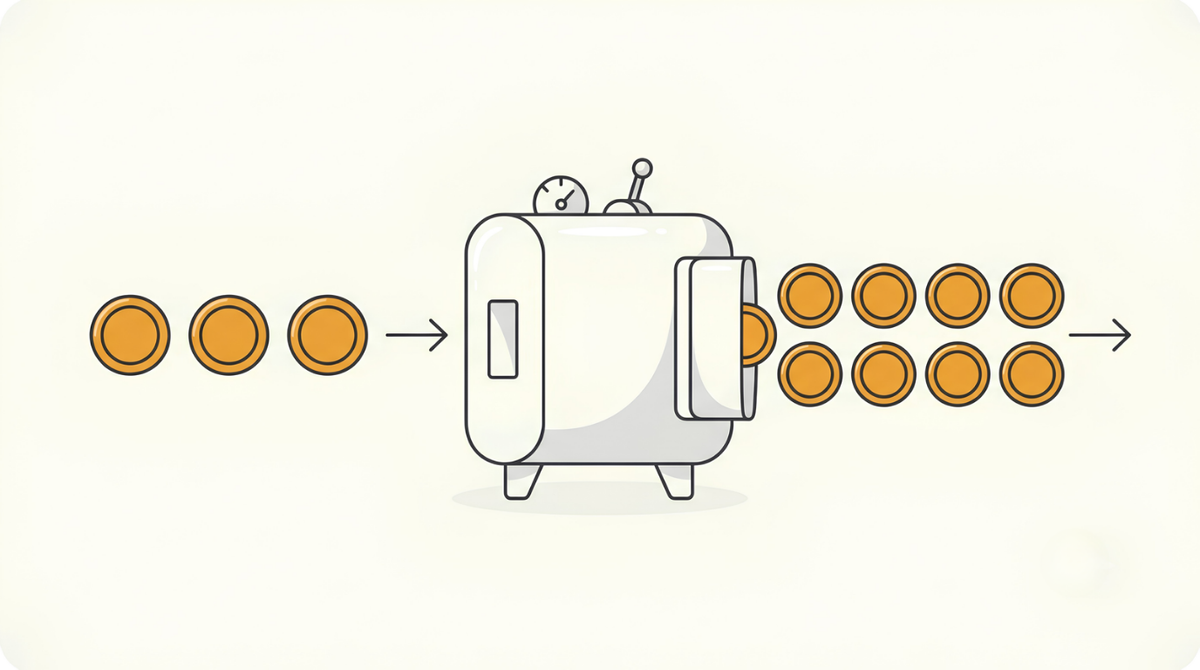
$2,211 of ad spend. $15,056.90 back. 682 sales.
That is one campaign, running on mugs, over a year of it, and it is still running now.
What a lottery ad is
You bid a few cents, across a lot of listings and a lot of keywords, and you leave it alone.
That is the whole idea. Instead of picking a handful of keywords and paying to win the top slot, you sit in thousands of auctions at a price so low that losing costs you nothing. Most of those impressions go nowhere. A small share convert, at cents on the dollar.
It only works if you have the catalog to spread it across. One listing bidding six cents gets ignored. Ten thousand listings bidding six cents catch the traffic nobody else wanted at that price.
ACOS is just what you spent on ads divided by the sales those ads made, as a percentage. Spend a dollar, make ten in sales, that is 10 percent. Lower is better.
I have run these since I started selling, and the settings, bid levels and placement adjustments are written out step by step here.
One more thing worth saying before the numbers: every product type gets its own campaign. Mugs in one, shirts in another. Sharing a campaign blends them into one average, and then you cannot tell which product is carrying it.
The real numbers
The mug campaign is my oldest, so it is the one with a year of data behind it.
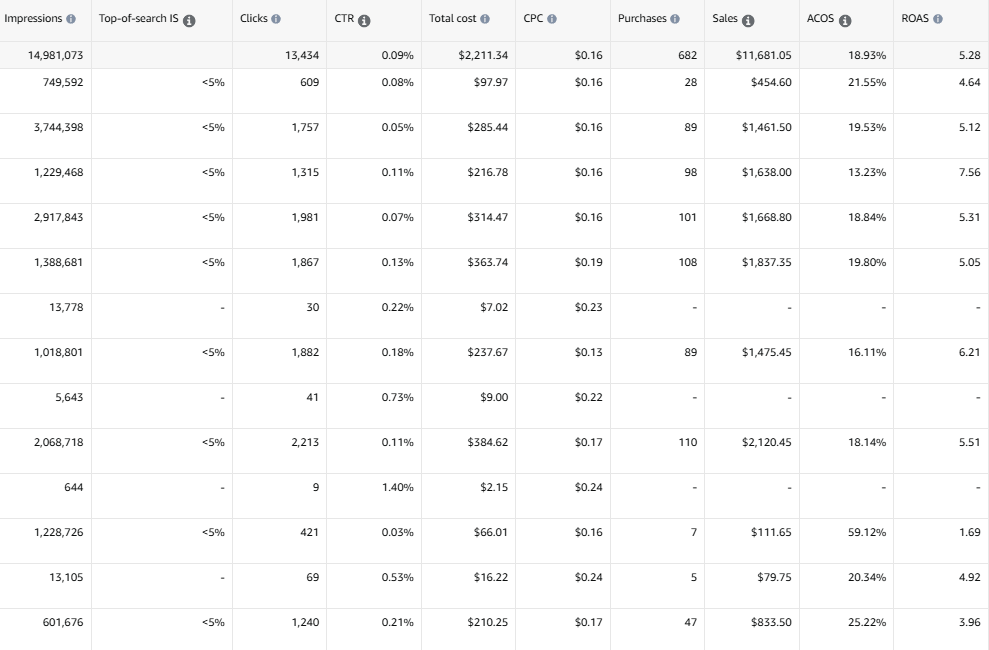
Thirteen thousand clicks at sixteen cents each. That is the mechanic in one line: the clicks are cheap enough that a 5 percent conversion rate still comes out ahead.
The 18.9 percent Amazon shows me is calculated on the $11,681 product revenue. It does not include the $4.95 shipping the buyer pays on every order, which is another $3,375.90 that landed with me. Count everything that came in and the figure drops to 14.7%.
Then the part people skip. Spread over 682 sales, $2,211 is $3.24 of advertising per order. On an item I would normally clear about ten dollars on, that leaves me roughly seven.
So the ads do eat into my margin, and I keep paying it.
I would rather make seven dollars on a sale that happens than ten on one that doesn't.
The organic sales still arrive on their own and still pay the full ten. The ad sales sit on top of them, from buyers who only found the listing because a six cent bid put it there.
They are not discounted sales. They are extra ones.
The shirts do not look like this
The mug campaign is the good one, and I am not going to pretend the rest match it.
The t-shirt campaign runs exactly the same way and performs much worse. It pulls impressions and it pulls clicks, so the ads themselves are working. Far fewer of those clicks turn into orders.
My read is competition. Shirts are where everyone in print on demand starts, and on Amazon that includes Merch on Demand sellers stacked into the same searches. A shopper who clicks my shirt has a wall of near identical ones to click next.
The fix was not clever. I lowered the bids, then lowered them again.
That campaign now gets a fraction of the visibility the mug one does. Fewer impressions, fewer clicks, and the sales it makes come in cheap enough to be worth having. Smaller and profitable is a fine outcome for a campaign I cannot make convert.
I am still moving those bids around, and I do not think a campaign is ever finished.
Talk soon,
Nick T