The One Part of My Print on Demand Business I Still Do by Hand
Most of the work that keeps my print on demand store running, I don't do anymore.
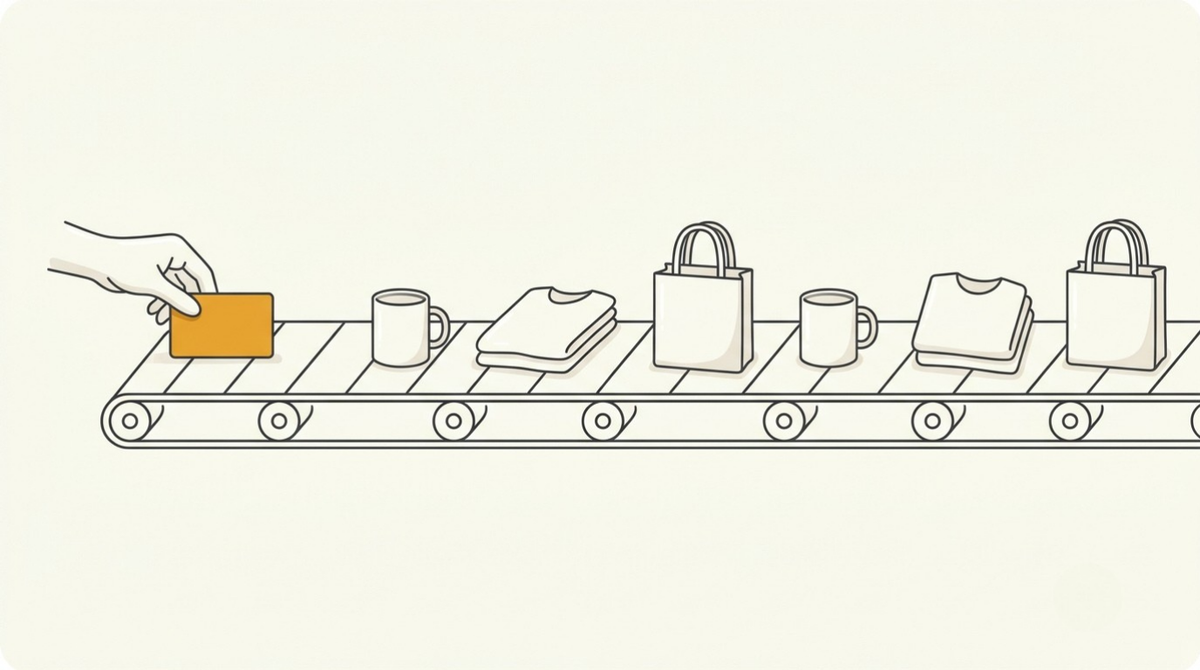
The research runs on its own. The mockups get built by a tool. The listing copy and the keywords come out of a prompt. Almost all of it sits on systems I built with Claude, and at this point I don't stand over it while it works.
If you are running a store by yourself, that is the part worth paying attention to, because what you automate decides what is left of your week.
One part of it never moved.
Three jobs I stopped doing
Design research used to be the slow one. Going through what is already selling, one listing at a time, eats an afternoon and gives you very little back for it. Put a tool on the same job and the afternoon turns into minutes.
Mockups went the same way. Tools like Photoshop will build them in bulk now, and nothing about the finished image tells you a person didn't sit there making each one.
Listings too. Give a model the right prompt and the title, the bullets and the keywords come back usable. That is the one that surprised me, because writing listings used to be the job I put off longest.
I trust all three of those. Not "run it and then check every one" trust. Actual trust. They run, I look at what came out, and I move on.
None of that is really about the tools, though. It is about having a process at all. A process is what turns a job from something you sit down and do into something that happens whether you sit down or not, and time is the one thing in this business you can't get more of. I wrote out how the listing side of my store got built here.
Then there is the design
The design is the part I never handed over.
Not because the tools can't do it. They can. AI image generators have got good, and plenty of what they make would sell perfectly fine on a product. That isn't the argument.
The argument is what a design is actually for.
AI can design. It still can't tell you what a person wants to wear.
You are selling to a person
The whole job, the only job really, is putting the right product in front of the right person.
You are not selling to an algorithm. You are selling to a person.
And to put the right thing in front of someone, you have to understand who they are. What they find funny. What they would put on a mug and hand to a friend. What reads as thoughtful to that specific group, and what reads as something a stranger made for them.
That isn't a research problem you can solve by pointing software at it. It's a people problem. A tool can tell you a phrase is selling. It can't tell you why that phrase lands with those people, or what the next one should be.
AI doesn't understand people the way people do. Not yet.
I still use AI on the design. I just don't hand it the decision.
This isn't me drawing everything by hand while everyone else automates. I use the same tools on the design that I use everywhere else. I generate, I iterate, I let software do the work my hands would be slower at.
The difference is who is making the calls. I write the prompt. I decide what the design is trying to say and who it is saying it to. I look at what comes back and I say no to most of it. The tools execute, and I steer every move.
That is a completely different relationship than the one I have with the mockups, where I genuinely am not involved anymore.
Automate everything around it
If you are building a store and you are still doing the research, the mockups and the listings by hand, automate them. All of them. There is nothing precious in there, and the hours you get back are real.
But I wouldn't hand over the design. Not yet.
Automate everything you can. Just not the part where you decide what a person wants.
I keep moving the line between what I run and what runs itself, and it has moved further than I expected it to. If you want to follow that as it happens, you can follow the build by email.
Talk soon,
Nick T