No Barcode? You Can Still Sell on Amazon


You cannot list a single print on demand product on Amazon until you clear one rule. Every product needs a barcode, and yours doesn't have one.
That is the wall. You finish setting up your seller account, you go to add your first shirt, and Amazon asks for a product ID you don't have and never will.
The fix is a GTIN exemption. It's Amazon's permission to list a product without a barcode, and for print on demand you can have it in about two clicks. So before that wall stops you, here's how to walk straight through it.
Why Amazon asks for a barcode you don't have
Amazon wants every product to carry one unique number so its giant catalog stays clean, one code for one product. That number is a GTIN.
A GTIN is just the number underneath a barcode. The UPC on the back of a cereal box is a GTIN. Big brands buy these codes and print them onto their packaging so Amazon, and every other store, can tell one product apart from the next.
Print on demand has none of that. Your supplier prints a shirt only once someone orders it. There is no warehouse, no packaging run, no barcode, and there never will be.
So you are caught between a rule that demands a code and a product that will never carry one. The exemption is how Amazon settles it.
The exemption isn't a hoop to jump through. It's Amazon agreeing that your kind of product doesn't need a barcode.
For print on demand, this is the easy part
Search "GTIN" and you'll find long guides about product photos, packaging shots, and letters from manufacturers. None of that is for you.
All of it applies when you want to list under a real, registered brand name. You're not doing that. Your products go up as Generic, which is simply Amazon's label for an unbranded item, and the Generic route skips the photos and the paperwork completely.
For print on demand, it takes about two clicks.
How to get your GTIN exemption
First you need a live Amazon seller account. If you haven't set that up yet, it's part of the wider one-time setup, which I broke down step by step here. With that in place, the exemption itself goes like this:
- In Seller Central, open Catalog, then Add Products. Choose Blank form and click Start.
- In the Item Name field, type a plain name for the product, something like "Leaf Print Tough Phone Case." Amazon reads the name and suggests a product type. Confirm its guess, or pick a closer one.
- Open the Product Identity tab. Tick "This product does not have a brand name." Tick "I don't have a product ID." If your product comes in different sizes or colors, tick "This product has variations" as well.
- Click Next. A pop-up appears telling you the exemption is approved. Click Acknowledge.
That's the whole thing. No upload, no waiting, no review sitting in a queue for two days.
Once the pop-up clears, you don't need to finish the listing on Amazon at all. The exemption now sits on your account, and your actual products get pushed live from your supplier's side. You can close the tab.
One exemption doesn't cover your whole store
Here's the one catch worth knowing. The exemption is granted per product category, not per product, and not for your account as a whole.
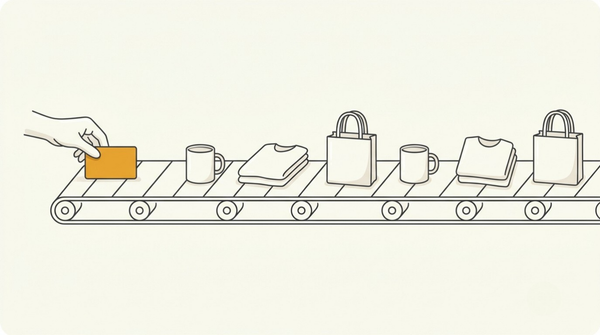
So the approval you just got covers shirts. The day you add a mug, Amazon treats that as a fresh category and asks all over again. Same two clicks, same instant approval, but you do have to repeat it for each type of product you sell.
When Amazon skips the exemption entirely
Sometimes you'll run the steps above and no pop-up appears. Instead you land straight on the normal listing page.
That isn't an error. It means the category you picked doesn't require an exemption in the first place, so you're already clear to list. Close the tab and carry on.
Either way, the barcode rule that looked like a locked gate turns out to be one that swings open the moment you push on it. Clear the exemption for the categories you'll sell in up front, and the last thing standing between you and a live listing is gone.
Talk soon,
Nick T