Stop Chasing the Next Shiny Method

If print on demand isn't working for you, the method probably isn't the thing that's broken.
What's broken is that you keep starting over.
You watched videos. One after another, late into the night. You read the articles. And you got excited, the real kind of excited, the kind that has you planning a whole new life in your head.
So you tried it. You did exactly what someone told you to do. Opened an Etsy shop, or signed up for Amazon Merch, followed every step. And it didn't work. A few weeks in, no sales, nothing moving. So you did the natural thing. You decided the method was a dud, maybe even a scam, and you went looking for the next one.
It isn't the method.
There's no magic formula in business. There never was. A business makes money for one reason: you give a customer something they actually want, at a price that works for both of you. That's the whole game. Every business on earth runs on that one thing, and print on demand is no different.
No method makes money on its own. It makes money when you get good enough to give people something they actually want.
So why isn't it working yet? Here's the part nobody likes to hear.
You're not good enough yet. And neither is anyone at the start.
That's not an insult, it's just how skill works. Print on demand is a skill like any other. It takes time to learn the platform and how buyers move around it. Time to figure out who your customer really is. Time to adjust your designs, your prices, your mockups, and the type of product you sell, until they line up with what people actually reach for instead of what you hoped they'd want.
What "getting good" actually means
It isn't one skill, it's a handful of small ones you sharpen over time:
The platform. How listings get found, what the rules reward, where buyers look first.
The customer. Who's actually buying, and the words they type when they want what you sell.
The offer. The design, the price, the mockup, and the product type, tuned until they match what people reach for.
Every run teaches you a little more about each one. That's the part switching throws away.
None of that lands on day one. You get it by doing it, looking at what happened, and fixing the next batch. Reps. There's no way to download it.
Now here's why switching hurts so much more than it feels like it should.
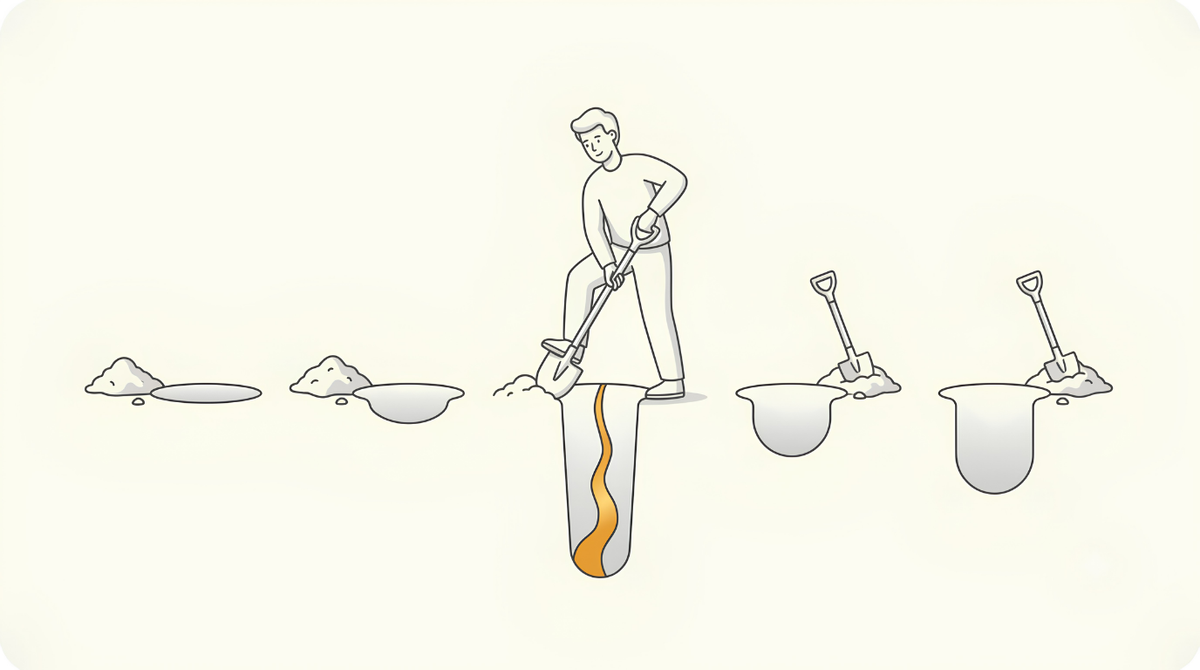
Every time you jump to a new method, you reset that skill back to zero.
Amazon, Etsy, Shopify. From the outside they look like the same job. They aren't. Each one asks for a slightly different skill set: different rules, different buyers, a different way of standing out in the crowd. The hours you sank into learning one don't fully carry over to the next. So you start the climb again from the bottom. Then you switch again, and start again.
Keep doing that and you never stay anywhere long enough to get good. Which means you never reach the part where it finally clicks.
💡 The quiet cost. Switching feels like progress because it's new and exciting. Usually it's the opposite: you're just paying the beginner tax all over again.
So what actually works?
Pick one method you genuinely believe in. Not the one with the loudest video. The one whose logic makes sense to you, where you can see why it could work and why it fits the way you want to work. Then stay. Do it over and over. Get the reps in. Learn the platform and the customer until you're not guessing anymore.
For me, that method is print on demand on Amazon FBM. One flat fee, and I can list as many designs as I want without paying for each one. I've written out the full reasoning behind why I went that way, so if you want to see it you can read it here. But honestly the method matters less than the staying. Whatever you land on, the rule doesn't change.
Every business takes skill, and skill takes time and repetition. Nobody skips that part. The people who get somewhere aren't the ones who found the perfect method. They're the ones who stopped switching long enough to get good at one.
Chasing the next shiny thing feels like progress. It's the thing quietly keeping you stuck.
Staying is what actually gets you there.
Pick your method. Then give it the time it deserves.
Stick with it,
Nick T